
Why the Safest Advertising Decision Is Usually the Worst One?
Thinking logically only really gets you to the same place as everyone else. Here’s why we sometimes deliberately go the other way — and why it tends to work.
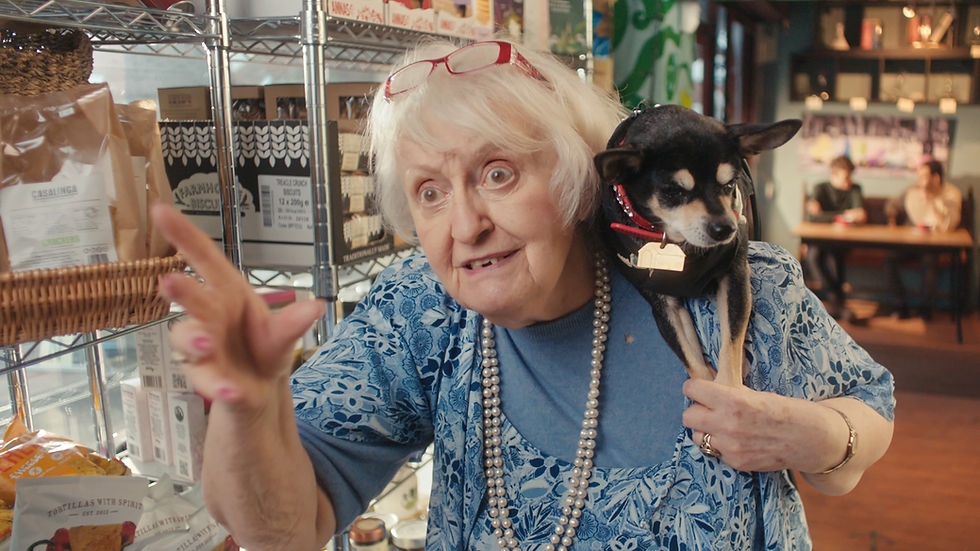
There’s a video we made for Pepe Saya — an Australian artisan butter brand — in which every single character featured fails to remember the name of the product. Not one of them gets it right. Now, on paper, this is an appalling idea for an advertisement. And the client, understandably, questioned this decision initially. You’ve been hired to promote a product and your creative strategy is to show customers who can’t name it? It shouldn’t work. And yet... it did — enormously. The film took off, the brand loved it, and it’s still one of the pieces of work I’m most pleased with. I don’t think that happened in spite of the seemingly illogical decision. I think it happened, at least in part, because of it.
The Logic Trap.
There’s a quote from Rory Sutherland — Vice Chairman of Ogilvy and one of the more interesting thinkers working in advertising today — that I keep coming back to:
“It is much easier to be fired for being illogical than it is for being unimaginative. The fatal issue is that logic always gets you to exactly the same place as your competitors.” — Rory Sutherland, Vice Chairman of Ogilvy.
This is the trap most advertising falls into. A creative decision has to be defended in a meeting, which then has to be defended in another meeting, and at every stage it gets sanded down to something that can be justified rationally. Something safe. Something that makes sense on a brief and doesn't scare anyone on the board of directors. But the result is almost always the same... advertising that looks exactly like advertising. Melting butter on a piece of toast. Smiling families. A voiceover explaining what the product does in a warm but vaguely authoritative tone. Functional, defensible, forgettable. The problem isn’t that those ads are bad. It’s that they’re the same. And the same doesn’t stick.
The Case for Psycho-Logic
Sutherland’s book Alchemy is essentially a long argument for what he calls “psycho-logic” — the idea that human beings don’t make decisions rationally, and that advertising which treats them as if they do will consistently underperform advertising that doesn’t.
His favourite example is Red Bull. When it launched, it was, by any rational measure, a terrible product. Smaller can size than its competitors. Worse taste. Twice the price. Every logical signal said this should fail. Instead it made its founder a multi-billionaire. Why?
Because the apparent irrationality of it — the small can, the strange taste, the premium price point — sent signals that conventional logic couldn’t. It felt different. It felt like something that actually did something. The product’s weaknesses, in the right framing, became its strengths. This isn’t magic. It’s an understanding that people respond to signals, to feeling, to narrative — and that the most effective way to send those signals is often not the most obvious or data driven one.
Back to the Butter.
When we were working on the Pepe Saya film, we could have gone conventional, and in actual fact that is what they initially asked for. Beautiful slow-motion butter. Warm golden light. An artisan story. “Crafted with care” or something equally forgettable. That film would have been fine. It would have looked like every other artisan food product video and been forgotten at roughly the same speed.
We had been specifically tasked with tackling the fact that on account of their butter being round, when on the shelf customers were mistaking it for cheese. So instead of fighting people's perception, we flipped it and made it a feature, not a problem. So much so that customers (in the film) only know it as "the round butter". They knew it by the round shape. They knew the taste. They just didn’t know the name. The decision to put that on camera — to make the not-knowing-the-name the joke, the hook, the entire premise — was, by any conventional advertising logic, barmy. You’re supposed to reinforce the brand name and repeat it until it sticks.
But tt showed a sense of humour and self-awareness. It showed a brand confident enough not to take itself seriously. It pointed to the distinctive round shape as the real identifier — which was a smarter move than any amount of name repetition. And it was funny, which meant people watched it, shared it, and remembered it. The illogical decision was the right one. It just required a client brave enough to say yes to it.
Why ROI Is the Wrong Starting Point.
Here’s where this gets complicated, and honest. Measuring the return from a project like that is hard. Not because it didn’t work — it did — but because the effects of good advertising don’t arrive on a schedule. They compound quietly over time, in ways that don’t always show up cleanly in a dashboard.
A video that sits on your website for three years is generating value on every single visit. It’s telling your story to every potential client who lands on your homepage at 11pm when you’re not there to tell it yourself. It’s building a picture of who you are and what you’re like to work with before anyone has picked up the phone. You can’t put that in a spreadsheet. You can measure views and click-through rates and time on page. Those numbers are real and worth tracking. But they are not the whole picture — and confusing the measurable with the valuable is one of the more reliable ways to make bad, or at least ineffective marketing decisions.
“The problem with logic in business is that it is perfectly designed to get you to do things that have already been done before.” — Rory Sutherland, Alchemy
If your benchmark for success is a number that goes up this quarter, you will make conservative decisions. And that's great if that's what you want to do. But conservative decisions produce conservative results, if you're lucky. Conservative results look fine in a report and disappear without trace in the market.
Define What Success Looks Like Before You Start.
This isn’t an argument against measuring things. It’s an argument for measuring the right things, and being honest about what those are before you commission the work — not after.
Ask yourself: What impression do you want someone to have after watching? What do you want them to feel? What do you want them to do — and is that a decision they’ll make in the next 24 hours, or over the next six months? If the video is doing long-term brand work, measure it on long-term brand metrics. Are the right kinds of people getting in touch? Is the quality of your enquiries improving? Are people arriving at conversations already pre-sold on what you do? These things are harder to quantify. That doesn’t make them less real.
Give the Bold Idea Time
The uncomfortable truth about advertising is that you often don’t know whether it worked for a while. Some ads are easy to evaluate. The weird, funny, bold piece of work often operates on a longer timeline and through a different mechanism.
Now, let's not get ahead of ourselves... not everything bold works. This isn’t a manifesto for chaos. Some illogical decisions are just bad ideas dressed up as bravery. The difference — and it is a judgment call, which is why it’s hard — is whether the illogic serves something real. A genuine insight. A truth about the product. A feeling the audience will recognise.
The Pepe Saya film worked because the illogical decision was rooted in something true. They were a fairly small brand at the time and people really didn’t know the name. The round shape really was how they were likely to identify it. Our bold idea was just to turn the problem into a feature by slightly reframing it.
Very few of the big success stories in advertising — or in business, or in anything for that matter — came from doing exactly what everyone else was doing. The ones that get remembered got remembered because they were different enough to be worth remembering. Sometimes that takes a bit of nerve. Usually on both sides of the camera.
Want to make something worth remembering? Come and talk to us. We like the ones that require a bit of nerve.


Comments